Fundamentals · 10 min read
Can Ni60Cr15 Replace Ni80Cr20? Yes, Below 1050 °C — With Three Numbers Recalculated
On this page
The short answer: can Ni60Cr15 replace Ni80Cr20? Yes, if the element never exceeds about 1050 °C — but not by dropping the same wire into the same coil. Ni60Cr15 is roughly 50 °C weaker on ceiling and 2.8 % higher in resistance; that 2.8 % moves the power, which moves the surface load, which decides life. The substitution is a three-step calculation, not a swap — our engineering team at the wire factory runs it for you free of charge.
Key takeaways
- It is a material substitution, never a part-number substitution. Expect about 50 °C of ceiling lost and a re-sized element.
- The 2.8 % resistivity gap is the smallest part of the problem. The controller compensates for lost power, which restores surface load while the ceiling is already lower.
- Three numbers must be recomputed in order: resistance at element temperature, wire diameter, surface load. Skip the middle one and the third lies.
- Life tracks surface load to the third or fourth power, so a 20 % overload costs roughly half the hours, not 20 %.
- Do not attempt it above about 1050 °C, in sulphur-bearing atmospheres, or where the geometry is frozen.
Can Ni60Cr15 replace Ni80Cr20? The one-sentence answer
It can replace it as a material, but never as a part number — the grade change costs you about 50 °C of ceiling and forces a re-sized element.
The two names describe genuinely different alloys, not grades of one thing. Ni80Cr20 is nickel-chromium with iron held under about 1.5 %; Ni60Cr15 is a nickel-chromium-iron alloy where iron makes up roughly a quarter of the mass. That iron is why the grade is cheaper and why its oxide scale is less protective above 1000 °C: iron oxides form alongside chromia and break down sooner.
What does not change is the physics of the swap. Resistance follows resistivity, resistivity differs by about 2.8 %, and everything downstream — power, surface load, element life — inherits that difference. Our nickel-chromium resistance wire range covers both grades, which is exactly why the recalculation below matters more than the price difference.
NiCr 60/15 vs 80/20: what actually differs between the grades
Five numbers decide this substitution, and the one everybody quotes — the price — is the only one that does not affect the element.
Table 1. Ni80Cr20 and Ni60Cr15 on published reference values
| Parameter | Ni80Cr20 (Cr20Ni80) | Ni60Cr15 (Cr15Ni60) | Effect on the substitution |
|---|---|---|---|
| Nominal composition | ~80 Ni / ~20 Cr / Fe ≤1.5 % | ~60 Ni / ~15 Cr / Fe ~22–26 % | Iron replaces nickel: the cost driver and the oxidation limit |
| Resistivity at 20 °C | 1.09 Ω·mm²/m | 1.11–1.12 Ω·mm²/m | +2.8 % → power and surface load both move |
| Max continuous element temp, air | ~1,200 °C | ~1,150 °C | Practical gap is nearer 50 °C, and wider above 1000 °C |
| Density | 8.40 g/cm³ | 8.20 g/cm³ | Same mass, marginally more metres |
| Scale behaviour above 1000 °C | Dense, adherent chromia | Chromia plus iron oxides, faster breakdown | Decides whether the cheap grade lasts |
Published reference values for the grade classes named, at 20 °C unless stated. Not measurements from any single production lot. Grade equivalence must be confirmed against the certificate by chemistry and material number.
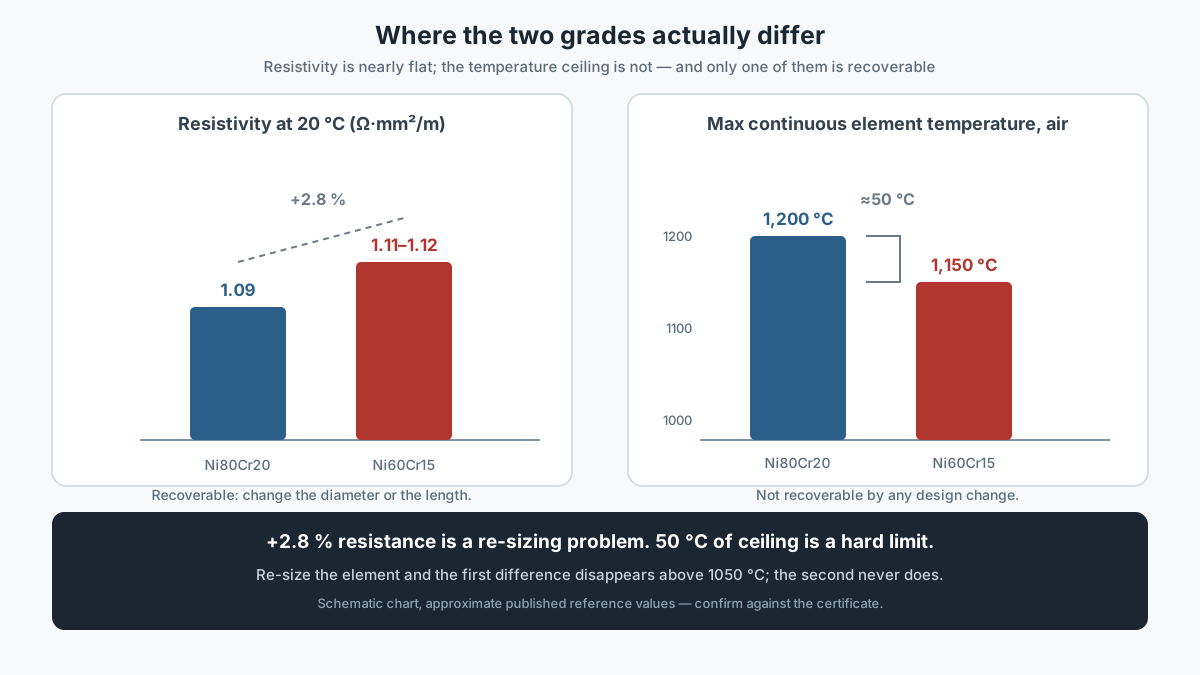
The 2.8 % is real but it is not the whole story. At matched diameter and length the higher-resistivity grade draws about 2.8 % more resistance and therefore delivers about 2.8 % less power at fixed voltage. That is inside most furnace tolerances — and it is still the smaller of the two effects, because a 2.8 % power drop means the element runs cooler, which means the controller pushes the setpoint up, which pushes the element temperature back up toward the ceiling you just lowered by 50 °C.
The three-step recalculation
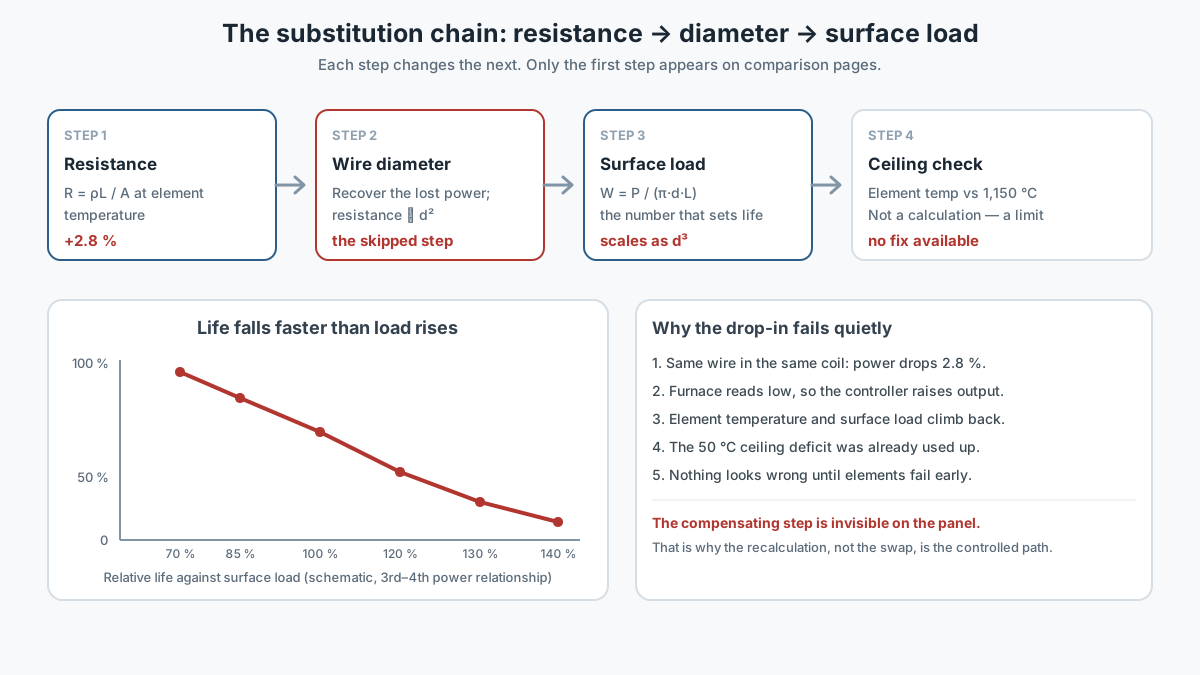
Three numbers have to be recomputed, in this order: resistance, wire diameter, surface load. Skip the middle one and the third one lies to you.
The 2.8 % figure is only the first number. Work the full chain on a real part.
Step 0 — fix the design target. Take a 3 kW, 230 V element designed in Ni80Cr20. Required hot resistance is about 17.6 Ω; at a conservative surface load the design lands on a wire in the 1.0–1.2 mm class and a length that fits the coil former. The figures for your part come from your own drawing; the sequence below is what has to be repeated.
Step 1 — recompute resistance, and remember which temperature you are using. Resistivity tables are quoted at 20 °C; the element runs at 900–1100 °C, where resistance is higher by the temperature coefficient. Swapping grades moves the 20 °C value by 2.8 %, and both grades drift upward with heat alike, so the relative error at operating temperature stays near 2.8 %. The absolute figure is what bites: 2.8 % more resistance is 2.8 % less power — about 85 W missing on a 3 kW element.
Step 2 — recompute the wire diameter. Holding length fixed, the way to recover the lost power is to reduce resistance per metre, which means a slightly larger cross-section. Because surface load scales with the cube of diameter while resistance scales with its square, a diameter change of a few percent moves surface load by roughly three times that percentage. That asymmetry is why the diameter step cannot be skipped: it is the most sensitive lever in the chain.
Step 3 — recompute the surface load. Surface load is power divided by exposed surface, and round wire offers π·d·L. If power and diameter both move, surface load moves by both. This is where the drop-in fails quietly: at matched diameter and length the substitute runs cooler, the controller compensates, and the furnace reads correct while element temperature and surface load have both climbed. Life then falls on the 3rd-to-4th-power law — a 20 % overload costs about half the hours, not 20 %.
Table 2. What each step changes, and who owns it
| Step | What you recompute | Typical ownership | What breaks if skipped |
|---|---|---|---|
| 0 | Power, voltage, target hot resistance | Design engineer | Nothing — but the rest has no anchor |
| 1 | Resistance at element temperature, not 20 °C | Design engineer | Power error is carried forward silently |
| 2 | Wire diameter for the new resistivity | Design engineer + supplier | Surface load ends up uncontrolled |
| 3 | Surface load against the grade’s allowance | Process engineer | Early failure blamed on “bad wire” |
| 4 | Ceiling check: element temp vs 1150 °C | Process engineer | Brittle, short-lived elements after months |
| 5 | Certificate and material number | Quality / procurement | You may receive the wrong grade entirely |
Sequence applies to any same-family grade substitution, not only this pair.
What Ni60Cr15 is often confused with
Three neighbouring names get mixed into this decision, and two of them are not substitutes at all.
| Confused with | What it actually is | Why it is not the same move |
|---|---|---|
| Ni80Cr20 “with less nickel” | A different alloy family member — Ni-Cr-Fe, not a diluted Ni-Cr | Iron changes scale behaviour, not just price |
| NiCr 70/30 | Higher-chromium nickel-chromium, same 1,200 °C ceiling but better oxidation resistance in sulphur-free air | It buys atmosphere resistance, not temperature headroom — and it is not a cost-down |
| FeCrAl (Kanthal-class) | Iron-chromium-aluminium, ~1,400 °C | A cross-family swap: resistivity differs by ~30 %, so it is a redesign |
| Ni60Cr15 under another trade name | Same chemistry sold as Cr15Ni60, Nikrothal 60, Resistohm 60 | The same material — verify by material number, not by name |
Ni60Cr15 is not a registered trademark the way Kanthal is; it is a chemistry several mills sell under their own names. That is where quality teams lose real time. Ask for the material number and the chemistry together — DIN 2.4867 with roughly 55–61 % Ni and 22–26 % Fe is Ni60Cr15, while DIN 2.4869 with Ni ≥75 % and Fe ≤1 % is Ni80Cr20. A quotation that names one material number and analyses as the other is the single most common substitution failure, and it is invisible until the element dies early.
The four misconceptions that cost money
Every one of these turns a 2.8 % calculation into a failed furnace.
“Same family, so it is a drop-in.” Same family means the same scale chemistry and the same failure modes — not the same resistance. The 2.8 % is small enough to look acceptable and large enough to shift the surface load once the controller compensates.
“The temperature difference is only 50 °C, and I have margin.” The 50 °C is not a uniform discount. Below about 1000 °C the two grades behave similarly; above it the gap widens quickly because iron oxides enter the scale. A furnace running at 1000 °C workload with an element at 1100–1150 °C is already at the substitute’s ceiling, margin or not. Check your nichrome 60/15 maximum temperature against the element figure, not the furnace figure.
“Power changed 2.8 %, so life changes 2.8 %.” Life does not track power linearly. It tracks surface load to the third or fourth power, so small thermal overloads produce large life reductions.
“Cheaper per kilo means cheaper per heating hour.” The purchase price is one line. The comparison that matters is cost per running hour: element price divided by achieved life. A grade that costs 20–30 % less and lasts half as long is the more expensive option, and the 2.8 % recalculation is what tells you whether that trade is being made deliberately or by accident.
When the substitution should not be attempted
Three conditions rule Ni60Cr15 out entirely, and they are not negotiable with a better calculation.
- Element temperature above roughly 1050 °C. The 50 °C gap is a hard limit, not a design variable. A furnace that once ran a Ni80Cr20 element near 1,150–1,200 °C has no margin left.
- Sulphur-bearing or other aggressive atmospheres. The lower-chromium, iron-bearing scale is the less protective of the two; where scale adhesion is already the failure mode, the cheaper grade accelerates it.
- Where the element geometry cannot change at all — a sealed cartridge, a fixed coil former, a wound element inside a ceramic body. If length and diameter are frozen, you are stuck with the 2.8 % power loss and the compensating controller behaviour described above, which is the worst of both options.
If any of those applies, the answer to the question is no, and the cheaper grade is not a saving.
What to put on the enquiry before you order
Five items on the enquiry turn this from a judgement call into a checkable answer.
- The material number and chemistry, not the trade name —
Ni60Cr15, DIN 2.4867orNi80Cr20, DIN 2.4869 / ASTM B344. - The element temperature you expect, stated separately from the furnace temperature; the element always runs hotter.
- The surface load the rating assumes, so the supplier’s number and your number are the same number.
- Resistance tolerance per metre or per coil, since grade substitution and winding tolerance both land on the same power figure.
- The certificate you will receive, with heat number and measured resistivity per lot. Expect an EN 10204 3.1 mill test report covering heat chemistry, mechanical properties, dimensions and traceability to coil or spool number, plus a certificate of conformity against the agreed standard. How we test and certify resistance wire shows what that looks like.
Once those five are on paper, the substitution has a defensible answer instead of a hopeful one. For the temperature-ceiling side of the same family, see choosing between NiCr and FeCrAl — the cross-family swap that needs a full redesign rather than a recalculation.
Frequently asked questions
Can Ni60Cr15 replace Ni80Cr20?
Yes, below about 1050 °C element temperature, provided the element is re-sized rather than swapped. At identical diameter and length the 2.8 % higher resistivity cuts power by roughly the same margin, and compensating through the controller raises both element temperature and surface load.
What is the resistivity difference between Ni60Cr15 and Ni80Cr20?
Published values put Ni80Cr20 at 1.09 Ω·mm²/m and Ni60Cr15 at 1.11–1.12 Ω·mm²/m at 20 °C — about 2.8 % higher. Confirm the exact figure on the certificate, because grade tolerances overlap between mills.
How much temperature capability do I lose?
Roughly 50 °C: about 1,200 °C for Ni80Cr20 against a nichrome 60/15 maximum temperature of about 1,150 °C in clean air. In practice the grades behave similarly up to about 1000 °C, and the gap widens above that as iron oxides weaken the scale.
Do I need to change the wire diameter when substituting?
Usually yes, if you want the same power. Reducing resistance per metre means a slightly larger cross-section; because surface load scales with the cube of diameter, that small change has an outsized effect on life and should be calculated, not guessed.
Is Ni60Cr15 cheaper than Ni80Cr20?
Normally yes, because iron replaces roughly twenty percentage points of nickel. Compare cost per running hour rather than cost per kilogram — a shorter life can erase the saving entirely.
Can the two grades be mixed in the same furnace?
Not on the same controlled zone. Different resistivities and thermal expansion put unequal load on shared supports and drive unequal power in a parallel circuit; use one grade per zone and note it on the element drawing.
Substituting Ni60Cr15 for Ni80Cr20?
Send the element drawing, expected element temperature and surface load. We will run the three-step recalculation for your part and confirm whether the cheaper grade is a saving or a rework.
Contact Us →