Fundamentals · 7 min read
Nichrome vs Kanthal: A Side-by-Side Comparison of Two Alloys
On this page
The nichrome vs Kanthal question has a one-line answer: nichrome is a nickel-chromium resistance alloy, and Kanthal is an iron-chromium-aluminium one. Both turn current into heat through their own resistance; the difference is the oxide layer they grow — chromia on nichrome, alumina on Kanthal — and that single difference sets the temperature ceiling, the failure mode and the handling rules for each. As a supplier of both, we stock the grades side by side and ship whichever fits your furnace.
Neither is a grade. Both are names that arrived before the standards did, and that is the first thing to fix before comparing them.
Key takeaways
- Nichrome = nickel-chromium, Kanthal = iron-chromium-aluminium. Different families, not different grades of one thing.
- The oxide layer is the whole mechanism. Chromia is adherent and re-forms after cycling; alumina is denser and more refractory but needs free oxygen.
- Neither name is a specification. Order the chemistry and the standard number — ASTM B344 for NiCr, ASTM B603 for FeCrAl.
- Temperature alone does not decide it. The two families overlap between roughly 800 and 1,200 °C, where atmosphere and cycling matter more.
Nichrome vs Kanthal: the one-sentence definition
Both are resistance heating alloys: wire drawn from an alloy chosen so its resistance makes heat and its surface survives the heat it makes. The word that decides which you are looking at is the oxide.
Heat a nickel-chromium wire in air and chromium at the surface reacts with oxygen to form chromium oxide, Cr₂O₃ — a thin, adherent, dark scale. Heat an iron-chromium-aluminium wire and aluminium migrates to the surface first and forms aluminium oxide, Al₂O₃. Alumina is denser, more refractory and slower to break down than chromia. That is the whole temperature story in one sentence, and it also explains why both alloys work at all: the scale is what stops the wire from consuming itself.
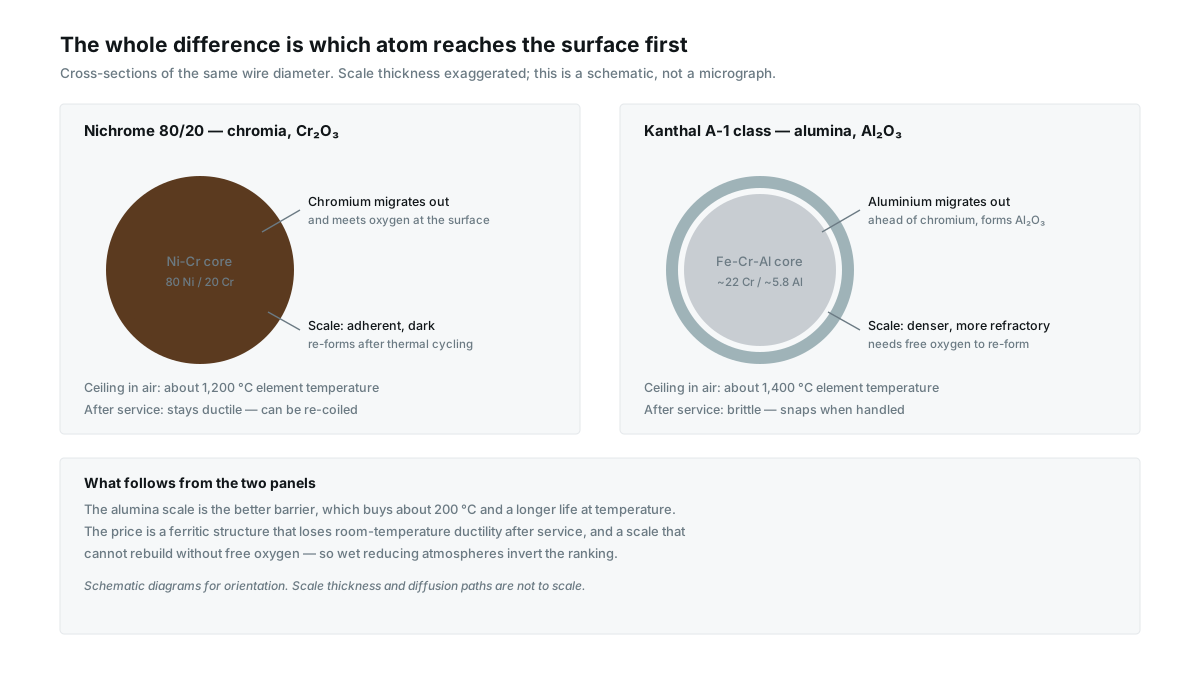
Our resistance and heating alloy wire range covers both families in wire and ribbon.
What you get from each name:
- Nichrome — a family of nickel-chromium alloys, most commonly 80 Ni / 20 Cr. Ductile, non-magnetic, weldable, and still ductile after service.
- Kanthal — a trademark for a family of iron-chromium-aluminium alloys, most commonly around 22 Cr / 5.8 Al / balance iron. Higher resistivity, magnetic, and brittle once it has been hot.
Are nichrome and Kanthal brand names or alloy types?
Kanthal is still a live trademark; nichrome is a trade name that became generic. Both began as product names — nichrome from the Driver-Harris company, Kanthal from the Swedish firm that introduced FeCrAl in the 1930s — but only one of them is still owned by anybody.
Nikrothal is the same company's name for its nickel-chromium line, which is the cleanest proof that "nichrome" and "Kanthal" are not opposites: one company sells both families under two trademarks.
The practical consequence arrives on the purchase order. Kanthal alone specifies nothing a mill can quote against; FeCrAl, 0Cr21Al6 to ASTM B603 does. Under the standards, resistance heating alloy grades are defined by chemistry — ASTM B344 for nickel-chromium, ASTM B603 for FeCrAl — and grade naming differs again across DIN 17470 and GB/T 1234. Order the chemistry and the standard number, and treat the trade name as a nickname.
Nichrome vs Kanthal: the five numbers that define both
Five figures separate the two families, and only one of them is a temperature. The other four decide whether the element fits, how much wire it takes, and what happens when it cycles.
Table 1. Nichrome 80/20 and Kanthal A-1 class compared on published reference values
| Parameter | Nichrome 80/20 (NiCr) | Kanthal A-1 class (FeCrAl) | Why the number matters |
|---|---|---|---|
| Nominal composition | 80 Ni / 20 Cr | ~22 Cr / ~5.8 Al / bal. Fe | Sets magnetic behaviour and joining method |
| Resistivity at 20 °C | 1.09 Ω·mm²/m | 1.35–1.45 Ω·mm²/m | Same power from a shorter length or finer gauge |
| Max continuous element temp, air | 1,200 °C | 1,400 °C | Element temperature, not furnace setpoint |
| Density | 8.4 g/cm³ | 7.10 g/cm³ | Equal mass gives roughly 18% more metres of FeCrAl |
| TCR, 20–1,000 °C | ≈100 ppm/°C | ≈50 ppm/°C | How far power drops between cold and hot |
| Ductility after service | Stays ductile | Becomes brittle | Decides whether the element can be re-coiled |
Published reference values for the grade classes named, at 20 °C unless stated. Not measurements from any single production lot. Equivalence must be confirmed against the certificate by chemistry and specification number.
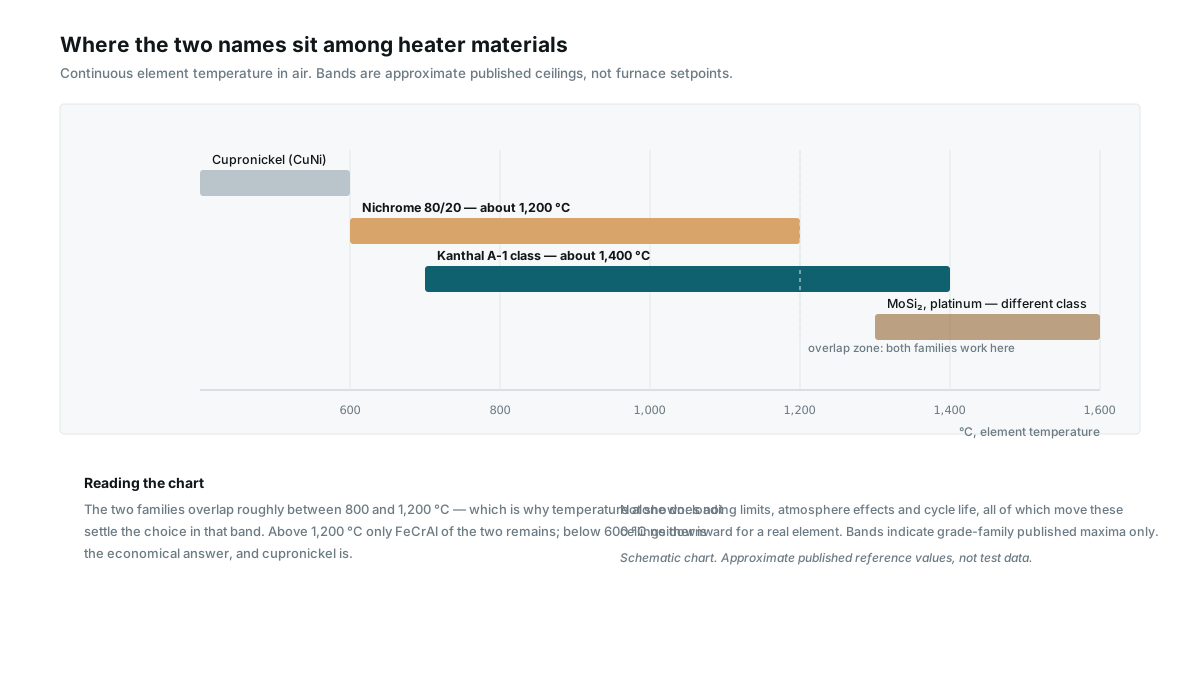
Two of those rows are routinely misread, and the misreading is expensive.
The temperature row is an element temperature, not a furnace temperature. A 1,400 °C alloy does not make a 1,400 °C furnace. The element always runs hotter than the workload, and the figure assumes clean dry air, a moderate diameter, a conservative surface load and no severe cycling. Use it as a ceiling for the wire, not a setpoint for the chamber.
The resistance row is not a "better conductor" comparison. Higher resistivity is neither good nor bad on its own; it changes how much wire you need. FeCrAl at roughly 1.4 Ω·mm²/m against nichrome's 1.09 means a shorter element, or a finer gauge, for the same wattage — which matters when the housing is tight and does not matter when it is not.
What each alloy is confused with, and why it matters
Both names get used for things they are not: nichrome is treated as a synonym for resistance wire, and Kanthal as a synonym for FeCrAl in general. Three neighbouring categories get mixed in, and each confusion leads to a different specification error.
| Confused with | What it actually is | How it differs |
|---|---|---|
| Resistance wire (the category) | Any wire specified for its resistance | Heating needs oxidation life as well; a resistor alloy like Manganin holds a value instead of making heat |
| Nikrothal / Alchrome / Alloy 875 | Other trade names for the same two families | Same chemistry, different trademark — not a third material |
| Cupronickel (CuNi) | Copper-nickel heating alloy, ceiling near 600 °C | Far lower resistivity, far more ductile, wrong above roughly 600 °C |
| MoSi₂, SiC, platinum | Ceramic and noble-metal elements for the top of the range | A different class of element entirely, with different supports and controls |
Table 2. Neighbours that get mistaken for the two families. One alloy can serve two categories, but the duty decides which requirement governs.
When people ask about nichrome vs Kanthal, they are usually comparing two specific products rather than two categories, which is how the neighbouring names get mixed in.
The distinction that saves the most money is the first row. Nichrome and Kanthal are heating alloys; "resistance wire" is the job title. If your requirement is "2 Ω, and still 2 Ω at 80 °C", you are describing a precision resistor alloy, not a heating alloy, and neither name is the answer.
The four misconceptions that cost money
Nearly every wrong specification in this pair comes from treating a rating as a promise, or a trade name as a grade. Four versions of that error account for most of them.
"Kanthal is simply the better alloy." It is better above roughly 1,200 °C and at high surface load. It is the wrong choice in wet reducing atmospheres, where it cannot rebuild its alumina scale, and in any element that must be handled or re-coiled, because it is brittle after service.
"Higher resistivity means more heat." Resistivity tells you what geometry you need. Power at fixed voltage comes from total resistance, set by length and diameter. Choosing the highest-resistivity grade "to get more heat" usually produces an element that will not fit.
"The rated temperature is what the furnace will reach." The rating describes the wire. The gap between element and workload depends on insulation, load, atmosphere and element arrangement — which is why a furnace built around a rating runs flat out and fails early.
"Nichrome and Kanthal are interchangeable if the diameter matches." A same-diameter swap moves power by 25–35% because the resistivities differ, and the shifted operating point changes the surface load, which changes life. The element appears to work and then fails ahead of schedule.
There is a fifth, quieter one worth knowing because it is a genuine trap in both families: FeCrAl embrittles even without high temperature. Held for a long time in the 400–575 °C range, it can lose room-temperature ductility — so an element that never saw its rated temperature can still arrive brittle at maintenance.
What this means before you write a specification
Two of the five numbers belong on your drawing, and the other three belong in your enquiry. Resistivity and diameter determine the element; temperature, atmosphere and wire form determine whether the family is right at all.
Concretely, before the first order:
- Name the chemistry and the standard, not the nickname —
NiCr 80/20 to ASTM B344orFeCrAl 0Cr21Al6 to ASTM B603. - State the element temperature you expect, and say whether the number is the wire or the workload. Many enquiries mix the two.
- State the atmosphere. Clean air, sulphur-bearing, wet reducing, vacuum — this is the one input that can reverse the family choice, and it is the one buyers most often omit.
- Ask what surface load the supplier's rating assumes. A temperature without a load is half a specification.
- Ask for the certificate you will receive, with heat number and measured resistivity, if you need it per lot. How we test and certify heating alloy wire shows what that looks like on our side.
Once those five are on paper, the comparison stops being a reading exercise. It becomes a decision with a checkable answer — which is the subject of the longer companion piece on choosing between NiCr and FeCrAl by service condition.
Frequently asked questions
Is nichrome the same as Kanthal?
No. Nichrome is nickel-chromium and Kanthal is iron-chromium-aluminium. They are two different alloy families that do the same job, and they differ in temperature ceiling, resistivity, magnetic behaviour and what happens to them after service.
Is Kanthal just a brand name for nichrome?
No — that is the most common mix-up. Kanthal is a trademark for FeCrAl alloys. Its owner also sells nickel-chromium alloys, under the separate name Nikrothal, precisely because they are not the same material.
Which is hotter, nichrome or Kanthal?
Kanthal, on published ratings: about 1,400 °C continuous element temperature in air for the A-1 class against about 1,200 °C for nichrome 80/20. Both are element temperatures under favourable conditions, not furnace setpoints.
Why does Kanthal become brittle?
Because of the alumina scale and the way FeCrAl behaves after thermal exposure: the alloy is ferritic, and after time at temperature it loses room-temperature ductility. An element that bent easily when new will snap when handled after service. Nichrome stays ductile because it is austenitic.
Can the two be joined or welded the same way?
Not identically. Nichrome welds with conventional resistance methods; FeCrAl forms a brittle heat-affected zone and needs the alloy maker's recommended joining method or a mechanical terminal. Neither solders with ordinary tin-based solder.
Which one is used in toasters and which in furnaces?
Nichrome dominates small appliance elements — toasters, dryers, fan heaters — because they are cycled hard and formed cheaply. FeCrAl dominates industrial furnaces and kilns because they run hot and steady. The split is about duty cycle, not about which alloy is better.
Bottom line: nichrome is nickel-chromium with a chromia scale and a 1,200 °C ceiling; Kanthal is iron-chromium-aluminium with an alumina scale, a 1,400 °C ceiling and a brittleness problem. Neither name specifies a grade, so the chemistry and the standard number are what belong on the order.
If you are still at the stage of working out which family fits your element temperature, atmosphere and wire form, tell us those three and we will name the family and grade — including when the answer is the one you had not considered.
Next step
Three numbers, and we name the alloy family
Element temperature, atmosphere, and wire form. We reply within 24 hours with the family and grade that fits, the surface load to design to, and — if the answer is the family you did not ask about — why.