Fundamentals · 9 min read
What Is Resistance Heating Wire? Definition, Grades and Limits
On this page
A resistance heating wire is a drawn alloy wire — usually nickel-chromium, iron-chromium-aluminium or copper-nickel — chosen so that its own electrical resistance converts current into usable heat, and so that its surface stays intact at the temperature that heat produces. It is a heating element, not a conductor. Everything below follows from that distinction — and from the drawing floor of a factory that has made these alloys since 2018.
Key takeaways
- Two numbers set the operating point, not one. Resistivity fixes cold power; the temperature coefficient fixes how far power falls once the wire is hot. NiCr 80/20 gains roughly 5% in resistance by 1,000 °C, so power falls by about the same share.
- The rated 1,200 °C of NiCr 80/20 is an element-temperature ceiling under favourable conditions — moderate diameter, low surface load, clean air, no severe cycling. It is not a furnace setpoint.
- Life is set by surface load (W/cm²), not by alloy alone. Downgrade the alloy, keep the watt density, and the element still fails on schedule.
- Below roughly 300 °C at high volume it is the wrong answer. Copper alloy resistance wire is cheaper and adequate.
What Is Resistance Heating Wire, and When Do You Specify It?
Specify it when the heat has to come from the wire itself, at the point of use, and the part must survive several hundred to well over a thousand degrees in air.
The mechanism is Joule heating: current through a resistive lattice deposits energy as heat at P = I²R, and the wire’s steady temperature is where that generation balances losses by radiation, convection and conduction. That is the whole design problem. The wire’s temperature is not a property of the wire — it is a property of the wire plus how well you let it cool. Our heating and resistance alloy wire range covers all four families below, in wire and ribbon.
Three conditions make this the right material class:
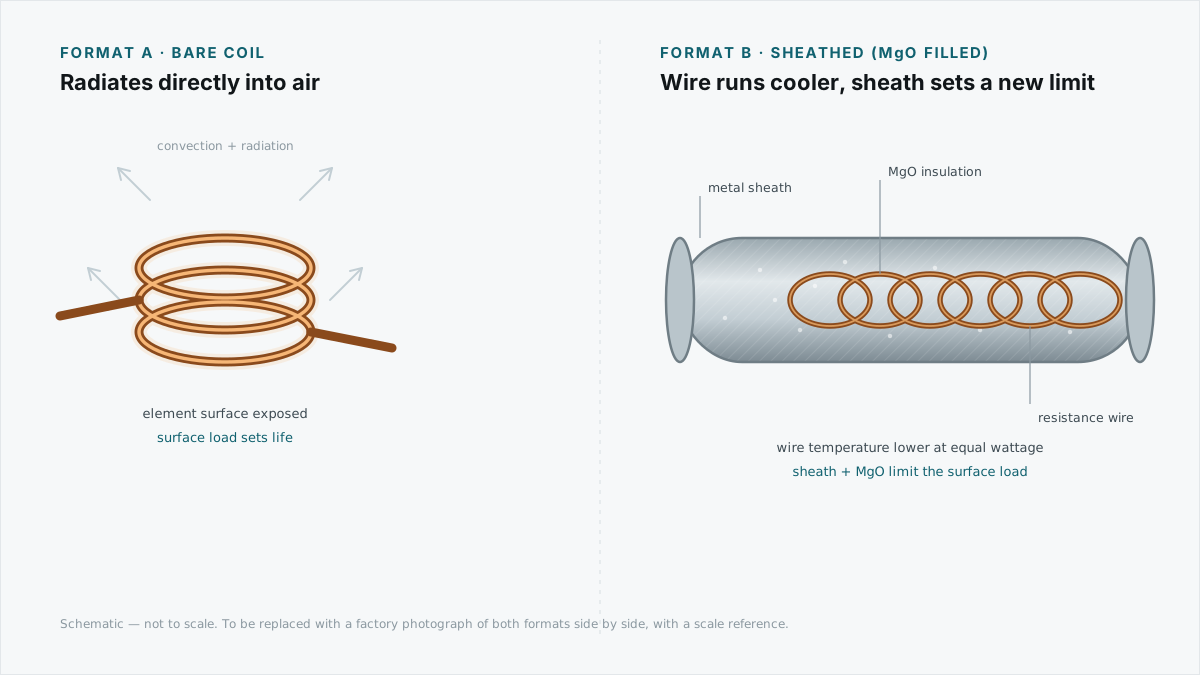
- The wire is the heat source, not a path to one — coils, ribbons, spiral elements, radiant panels, elements inside sheathed tubes.
- Operating temperature is above roughly 300 °C, where copper alloys stop being practical.
- It runs in air, or in an atmosphere you can name. Vacuum and hydrogen service change the selection completely.
The five wires that get confused with this one
Most specification errors we see are not grade errors. They are category errors: someone bought a wire with the right diameter and the wrong job.
Table 1. Functional requirements of wires that all look like “a thin metal wire”
| Wire class | Job it is designed for | Typical alloy | Defining requirement | Wrong here because |
|---|---|---|---|---|
| Resistance heating wire | Generate heat continuously | NiCr 80/20, FeCrAl | High resistivity plus oxidation life at temperature | — |
| Precision resistance wire | Hold a resistance value that does not move | Manganin, Constantan | Near-zero temperature coefficient, low EMF vs copper | Resistance drifts with temperature; the circuit no longer computes |
| Fuse element | Open the circuit once, permanently | Silver-plated copper, zinc | Reproducible I²t melting characteristic | It is a one-shot device; it will not hold a duty cycle |
| Thermocouple wire | Measure temperature by generating a voltage | Type K, J, N pairs | Two dissimilar alloys with a stable EMF curve | It is a sensor; there is no useful self-heating role |
| Sheathed heating cable | Spread low heat over long length | CuNi, self-regulating core | Long run at fixed watt per metre | Wrong format and wrong surface load for concentrated heat |
Classified by primary function. One alloy can serve two classes: NiCr 80/20 is both a heating alloy and a legitimate resistor alloy, but only the heating application tolerates its temperature coefficient.
Read the second row carefully, because it is the expensive one. If your requirement is “2 Ω, and still 2 Ω at 80 °C”, you want Manganin. If it is “2 Ω cold, and it must glow”, you want nichrome wire and you accept the drift.
Which alloy families are used, and what each is for
Four families cover almost the entire market, in distinct temperature bands.
Nickel-chromium (NiCr) is the general-purpose choice from about 600 °C to 1,200 °C. Ductile, weldable, non-magnetic, with useful hot strength — which is why it survives being coiled and re-coiled. Range details are on our nichrome alloy wire page.
Iron-chromium-aluminium (FeCrAl) reaches the highest air temperatures, roughly 1,300–1,400 °C element temperature, on an aluminium-oxide scale more protective than chromium oxide. It costs less per kilogram at equal temperature and is about 15% less dense, but becomes brittle after service: an element that was fine at installation may crack if touched after the first firing.
Copper-nickel (CuNi) is the low-temperature, controlled-resistance end: roughly 0.5 Ω·mm²/m, excellent ductility, ceiling near 600 °C. Heating blankets, low-density panels, warming cable. Nickel-iron and nickel-manganese fill in where moderate resistivity and low cost matter more than temperature — common in appliance duty, rarely right above 500 °C.
The consequence: temperature picks the family; resistance picks the grade within it. Doing that backwards is how a 0.9 Ω·mm²/m alloy ends up in a kiln.
Grade data you can actually design against
Resistivity at a stated temperature, maximum continuous element temperature in air, and the standard each grade is ordered against — a temperature with no standard behind it is a marketing number.
Table 2. Resistance heating wire grades, published reference values
| Grade | Resistivity at 20 °C (Ω·mm²/m) | Max continuous element temp, air (°C) | Melting point (°C) | Density (g/cm³) | Typical specification |
|---|---|---|---|---|---|
| NiCr 80/20 (Cr20Ni80) | 1.09 ± 0.05 | 1,200 | ≈1,400 | 8.40 | ASTM B344; DIN 17470 (2.4869) |
| NiCr 70/30 (Cr30Ni70) | 1.18 | 1,250 | ≈1,380 | 8.10 | DIN 17470 |
| NiCr 60/15 (Cr15Ni60) | 1.11–1.12 | 1,150 | ≈1,390 | 8.20 | GB/T 1234; DIN 17470 |
| FeCrAl, Cr25Al5 class | ≈1.35 | 1,250 | — | ≈7.1–7.3 | ASTM B603; DIN 17470 |
| FeCrAl, high-temperature class | ≈1.45 | 1,400 | — | ≈7.1 | ASTM B603 |
| CuNi 44 | ≈0.49 | 600 | — | ≈8.9 | ASTM B267 |
Published reference data for the alloy families, resistivity at 20 °C — not measurements from our own production. Starting points for element design, not acceptance criteria: the certificate for the lot you receive governs. Grade naming differs across ASTM, DIN, GB/T and JIS; confirm equivalence by chemistry and specification number, not trade name.
Resistivity tolerances are wide by design. The ±0.05 on a 1.09 nominal is about ±4.6%. If your element sits exactly at the edge of its wattage window, a compliant lot pushes it over. Design to the band, not the nominal.
Higher maximum temperature does not mean better. The FeCrAl grade rated 1,400 °C will fail faster than NiCr 80/20 in a furnace cycling daily at 900 °C, because the alumina scale spalls under cycling and the wire is more brittle to begin with. Rated ceiling and service life are different quantities, and only one appears in a datasheet.
Why the same wire gives two different power ratings
Resistance rises with temperature. NiCr 80/20 has a temperature coefficient of around 85–100 ppm/°C over 20–1,000 °C, roughly a 5% increase by 1,000 °C. At constant voltage power falls by the same proportion, because P = V²/R.
- Cold state: an element drawing 1,500 W at 20 °C draws roughly 1,425 W once the wire reaches 1,000 °C.
- The current rating must still cover the cold state. Inrush is the higher number, and it is what trips breakers.
- The thermal design must still cover the hot state. Assume 1,500 W of input and your warm-up will run long.
- CuNi and precision grades have much smaller coefficients, which is why they win in controlled-resistance warming.
When you see a wattage on an element datasheet, ask whether it is cold or hot. If the supplier cannot say, the number is not design data. The worked formulas are in resistance and wattage calculation for heating alloy wire.
The two limits that decide service life
Every high-temperature resistance alloy survives by forming a thin protective oxide scale, and dies when the scale stops healing — because the scale is a consumable that takes its chromium or aluminium out of the wire.
Element temperature limit. The published ceiling, assuming clean dry air, reasonable diameter, low surface load and no severe cycling. Sulphur-bearing or reducing atmospheres shorten life well below the rating.
Surface load limit. Watts per square centimetre of wire surface. This governs life at a given temperature, because it sets the scale temperature. Two elements of the same alloy at the same furnace temperature have completely different lives if one runs at double the surface load.
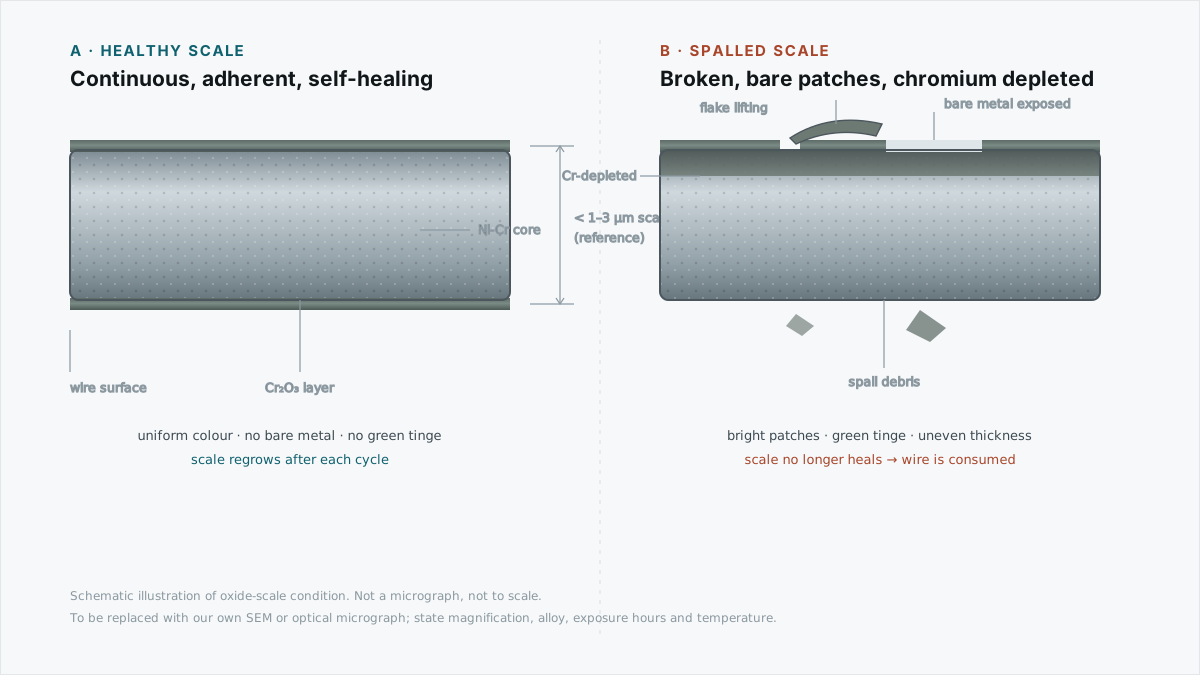
The corrosion side of the same problem — what kills elements early in real furnaces — is covered in the factors that affect service life.
The two misconceptions that actually cost money
“Thicker wire runs hotter.” Under fixed voltage, thicker wire means lower resistance, more current, more total power — but also more surface area. Within one alloy, the wire that glows brighter per unit area is the thinner one. What changes with diameter is the safe surface load and hot strength. Size diameter for surface load, alloy for temperature.
“The rated temperature is the furnace temperature.” A 1,200 °C alloy does not give a 1,200 °C furnace. The element runs hotter than the workload, and the gap depends on insulation, load, atmosphere and arrangement. Sizing on the element rating produces an element that runs flat out and fails early.
Two more follow from the definitions above, and both appear in the FAQ below: resistance wire is not heating wire, and high resistivity is not high power.
What to put on the purchase order
An order missing these five items gets filled to the mill’s standard, and the difference surfaces as a life-test failure nine months later.
- Grade plus specification number, not trade name alone.
NiCr 80/20 to ASTM B344is an order.Nichromeis a brand family. - Diameter with tolerance, and condition — bright, oxidised or annealed. Surface condition changes both first-firing behaviour and surface load.
- Resistivity with the tolerance you can accept, referenced to 20 °C.
- Delivery form and spool — coil weight, spool type, straight, spooled, or finished elements.
- The certificate you will actually receive. A mill test certificate to EN 10204 3.1 stating heat number and measured resistivity is normal for this class; if you need it per lot, say so before the order. Every lot we ship is documented this way — see how we test and certify alloy wire.
When resistance heating wire is not the right answer
- Below roughly 300 °C at high volume, copper alloy resistance wire or another heater format is cheaper and easier to form. Paying for NiCr at 120 °C buys nothing.
- Where the wire cannot be exposed to air. In vacuum or hydrogen, chromium-oxide-forming alloys lose their protection and the selection moves to molybdenum, tungsten or grades suited to reducing conditions.
- Where the element must take physical contact, such as abrasive or vibrating service. FeCrAl becomes brittle; NiCr is better but still not a structural member.
- Where heat must be uniform over a large area at low watt density. A heating cable, film or panel is the right format; a single wire always develops hot spots.
- Where nickel release is a compliance issue for the finished product. Some CuNi and FeCrAl grades avoid nickel entirely — verify against the actual requirement rather than assuming.
Frequently asked questions
What is resistance heating wire made of?
Almost always a nickel-chromium, iron-chromium-aluminium or copper-nickel alloy, drawn to wire or rolled to ribbon. The alloy is chosen for resistivity plus the ability to form a protective oxide scale at working temperature.
Is nichrome wire the same as resistance heating wire?
Nichrome is one family within it, not a synonym for the category. NiCr 80/20 is the best-known nichrome wire grade and the most widely used resistance heating alloy. FeCrAl and CuNi heating wires are also resistance heating wire, and are the better choice at the top and bottom of the temperature range.
What is the maximum temperature of nichrome wire?
About 1,200 degrees C continuous element temperature in air for NiCr 80/20, and about 1,150 degrees C for NiCr 60/15, assuming clean dry air, moderate diameter, conservative surface load and no severe cycling. In a sulphur-bearing atmosphere, in vacuum, or at high surface load the usable ceiling is lower.
Does resistance wire get hotter as it gets longer?
No. At fixed voltage, a longer wire has higher resistance, draws less current and produces less total power, which is why element length tunes wattage. What gets hotter is the wire with the higher surface load. This is why cutting a coil shorter to make it hotter is how elements burn out.
Can resistance heating wire be welded or joined?
It can be welded, but never twisted and taped. A twisted joint has high contact resistance, oxidises and fails at the joint. Use the alloy maker's recommended method or a proper high-temperature terminal, and keep the joint outside the hot zone.
How do I know which grade to order?
Start with element temperature and atmosphere, which narrow the family. Then use resistivity and available diameters to hit your target wattage, and check the resulting surface load. If those three steps do not converge, the problem is usually the mechanical envelope, not the alloy.
Is high resistivity the same as high power?
No. Resistivity tells you what geometry you need. Power at fixed voltage is set by total resistance, chosen by length and diameter. Picking the highest-resistivity alloy to get more heat usually yields an element that will not fit the housing.
Next step
Three numbers, and we name the alloy family
Element temperature, supply voltage, and the atmosphere it runs in. We reply within 24 hours with the family and grade that fits, plus the surface load you should design to. If nichrome is the wrong answer for your application, we will say so.