Fundamentals · 8 min read
Nichrome vs Stainless Steel Heating: Where the Two Alloys Actually Part Ways
On this page
The nichrome vs stainless steel heating question has a one-line answer: nichrome is a resistance alloy built to live at element temperature, and stainless steel is a corrosion-resistant structural alloy that happens to carry current. Both get hot. Only one was designed to stay hot, glowing, in air, for thousands of hours. That is the difference our factory builds for.
Key takeaways
- The roles are different, not the metals. Nichrome is the element; stainless steel is the sheath and structure around it. Most specification mistakes come from swapping those two jobs.
- Resistivity drift is what decides control behaviour. 304’s resistivity climbs about 40 % between 20 and 400 °C; nichrome stays within a few percent.
- Melting point is not a working limit. 304 melts above 1,400 °C but its element ceiling in air sits near 800–870 °C.
- Per-kilo price misleads. Same wattage needs around half again the wire length, and the element fails sooner — lifecycle cost usually reverses the answer.
Nichrome vs stainless steel heating: the one-sentence answer
Nichrome is an element alloy; stainless steel is a sheath and structure alloy, and most specification mistakes come from swapping those two jobs.
Both families lean on chromium. Heat nichrome 80/20 in air and its surface grows a thin, adherent chromia (Cr2O3) scale that is designed to reform at element temperature and stay put for the life of the coil. Stainless steel forms a passive chromium-oxide film too — but that film is engineered for wet, room-temperature service. Push 304 up toward element temperature and the same chromium starts producing a thick, spalling scaling oxide instead: the surface flakes, metal is lost, resistance climbs, and the wire thins toward burnout.
So the question is rarely “which metal conducts.” It is “which oxide layer survives the job.” Our resistance and heating alloy wire range exists because that survival is a designed property, not an accident of composition.
Nichrome vs stainless steel heating: can 304 serve as the element at all?
Yes — briefly, at low temperature, or where mechanical life matters more than electrical stability. Three properties stop it from doing element duty seriously.
Resistivity. Nichrome wire resistivity sits at about 1.09 Ω·mm²/m at 20 °C; 304 stainless is roughly 0.72 Ω·mm²/m. For the same wattage at the same voltage, the 304 element needs around half again the length, or a much finer gauge — awkward in a compact housing, and finer wire means less thermal mass and shorter life.
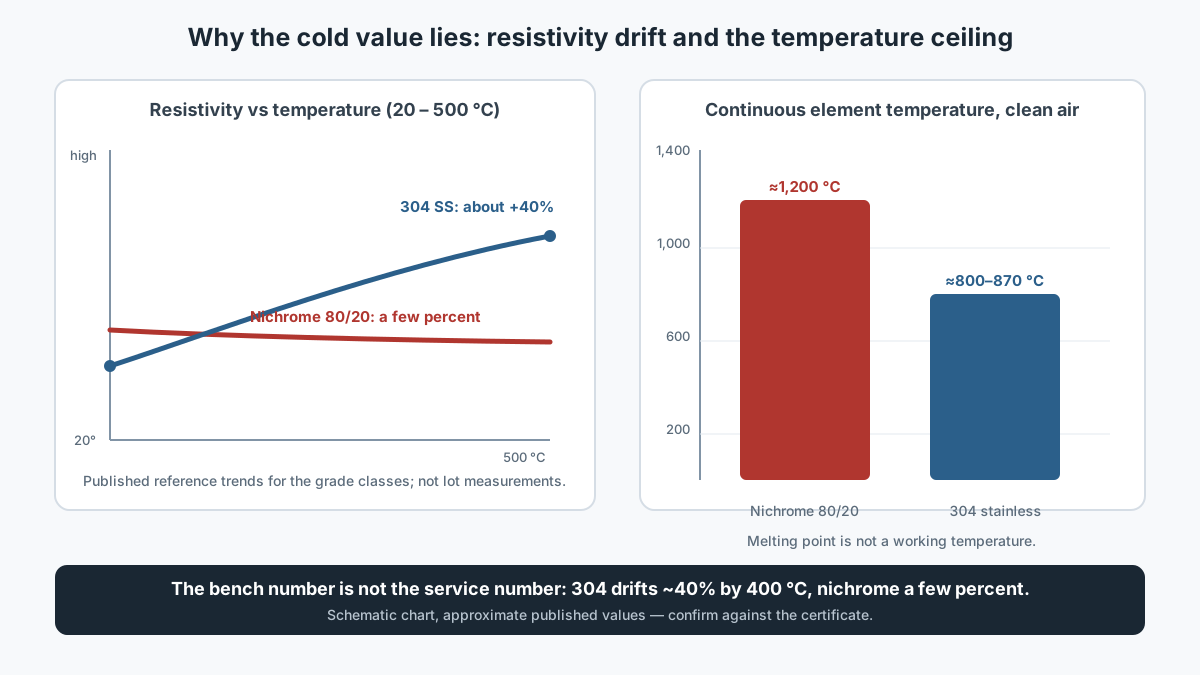
Resistance drift. Austenitic stainless steel’s resistivity climbs steeply as it warms — published reference data shows an increase of roughly 40 % between 20 °C and 400 °C. A cold-started 304 element therefore delivers far less power once hot than the design value, and the operating point moves with every cycle. Nichrome stays within a few percent over the same span, which is why controllers can hold a setpoint on it.
Scaling. Above roughly 800 °C in air, 304 begins to scale rapidly; the oxide spalls, each cycle removing metal. Nichrome’s ceiling for continuous element service in clean air is about 1,200 °C with a stable, adherent scale.
That leaves stainless steel honest work as a heating material: hot-wire foam cutters run for minutes, low-temperature cartridge duties, and — its biggest real role — everything around the element, which is the next section.
The five numbers that define the difference
Five figures separate an element alloy from a structural alloy, and only one of them appears on a datasheet cover page.
Table 1. Nichrome 80/20 and 304 stainless steel on published reference values
| Parameter | Nichrome 80/20 (NiCr) | 304 stainless steel | Why the number matters |
|---|---|---|---|
| Nominal composition | 80 Ni / 20 Cr | ~18 Cr / 8 Ni / bal. Fe | Nickel content is the price driver and the high-temperature enabler |
| Resistivity at 20 °C | 1.09 Ω·mm²/m | ≈0.72 Ω·mm²/m | Sets element length and gauge for a given wattage |
| Resistivity drift, 20→400 °C | A few percent | ≈ +40 % | Cold values lie; hot power is what the process sees |
| Max element temp, clean air | ≈1,200 °C | ≈800–870 °C | Ceiling for the wire, not the workload |
| Density | 8.4 g/cm³ | 8.0 g/cm³ | Minor, but enters every weight-based quote |
Published reference values for the grade classes named, at 20 °C unless stated. Not measurements from any single production lot. Equivalence must be confirmed against the certificate by chemistry and specification number.
Two of those rows are routinely misread.
The drift row is the one that decides control behaviour. A heater designed on the 20 °C resistance of a stainless element over-delivers when cold and under-delivers when hot — the process swings with the element’s own warm-up. With nichrome, the number you measured on the bench is still approximately the number in service.
The temperature row is an element temperature, not a furnace temperature. Neither figure is a setpoint; both assume clean dry air, moderate diameter, and a conservative surface load.
What stainless steel heating parts are often confused with
The most expensive confusion in this comparison is not about alloy chemistry — it is about which part of the heater each alloy belongs in. Four neighbouring categories get mixed together, and each mix-up produces a different specification error.
| Confused with | What it actually is | How it differs |
|---|---|---|
| Stainless as sheath material | The correct role: outer tube of cartridge, immersion and band heaters | Mechanical and corrosion duty at sheath temperature — a different job from making the heat |
| FeCrAl (Kanthal-class) | A second element alloy family, iron-chromium-aluminium | Higher ceiling (~1,400 °C), brittle after service; a rival to nichrome, not to stainless |
| Cupronickel (CuNi) | Low-temperature heating alloy, ceiling near 600 °C | Cheaper and very ductile, but wrong above roughly 600 °C |
| “Resistance wire” (the category) | Any wire specified for its resistance | Heating needs oxidation life as well; the category is a job title, not a material |
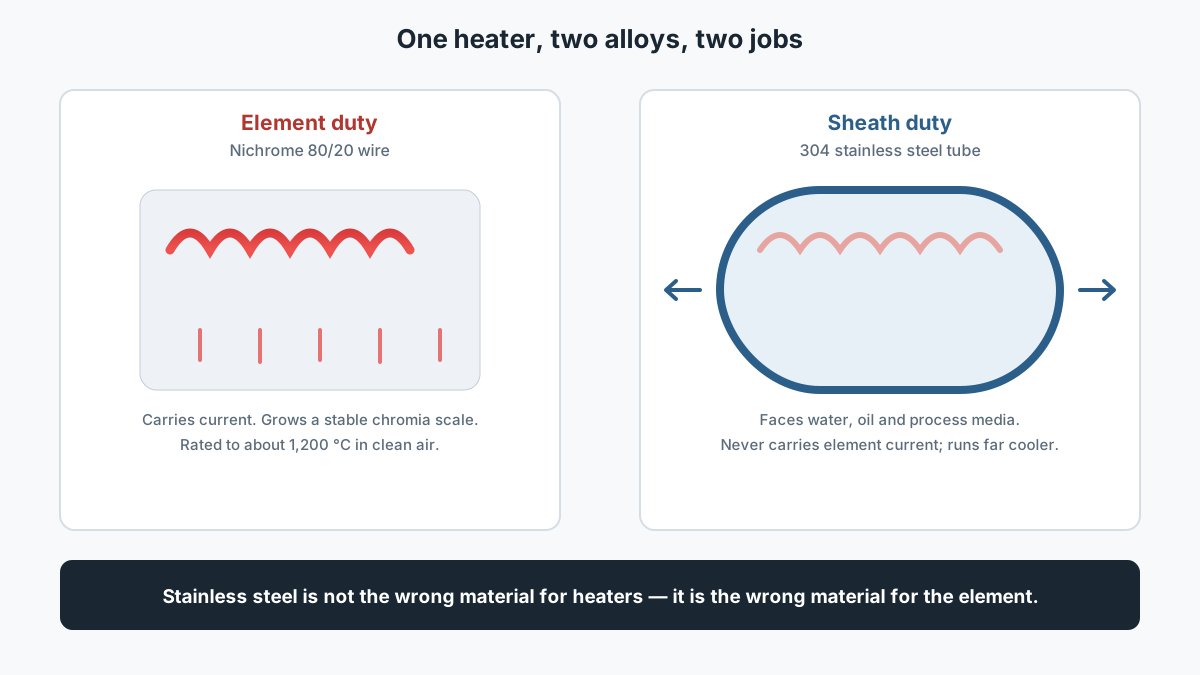
In a cartridge or immersion heater the stainless tube never carries element current. It survives water, oil and process chemicals, takes mechanical contact, and runs far below element temperature. That is structural-alloy work, and 304 does it excellently. Stainless steel is not the wrong material for heaters — it is the wrong material for the element.
The second row matters for the opposite reason. When engineers outgrow nichrome’s 1,200 °C ceiling, the upgrade path is FeCrAl, not stainless — see our companion piece on choosing between NiCr and FeCrAl by service condition.
The four misconceptions that cost money
Nearly every wrong specification here comes from reading a property that is true at room temperature as if it stayed true at element temperature.
“Stainless melts at 1,400 °C+, so it can heat to 1,400 °C.” Melting point sets no working limit. Scale spalling, creep and oxidation set 304’s element ceiling near 800–870 °C — some 400 degrees below where nichrome’s chromia scale is still intact.
“Stainless is cheaper per kilo, so the heater is cheaper.” The kilogram price is the cheapest line in a heater’s life cost. A stainless element needs more wire for the same wattage, drifts off its design point, and is replaced earlier; over the element’s life the material line is noise.
“A good conductor makes a better heater.” Heating is resistive, not conductive. Lower resistivity is a design handicap, not an advantage — it forces longer, finer wire for the same power.
“Any wire glows, so the alloy choice is cosmetic.” Glow is the easy part. Staying at the same resistance, the same power and the same geometry for thousands of hot hours is the specification, and that is exactly what a purpose-built resistance alloy buys.
When stainless steel is the right call
There are real cases where 304 is the correct wire — the skill is recognising them before the quote, not after the failure.
- Mechanical-first duties: hot-wire cutting of foam or webbing run for seconds to minutes, where edge life and stiffness outrank resistance stability.
- Low-temperature, cost-driven duties: trace heating and simple resistive duties comfortably below a few hundred degrees, where drift is tolerable.
- Everything around the element: sheaths, supports, terminals, armouring — 304’s home ground.
If any of those is the duty, specify the chemistry and the standard, not the nickname — for example 304 to ASTM A580 for stainless wire, NiCr 80/20 to ASTM B344 for the element — and state the expected element temperature and the atmosphere. Ask what surface load the supplier’s temperature rating assumes, and how heating alloy wire is tested and certified before it ships.
Once the duty is on paper, the comparison stops being a reading exercise and becomes a decision with a checkable answer.
Frequently asked questions
Is nichrome better than stainless steel for heating elements?
For element duty, yes. Nichrome carries roughly 50 % higher resistivity, drifts only a few percent with temperature, and holds a protective oxide scale to about 1,200 degrees C, where 304 begins scaling near 800–870 degrees C. Stainless steel’s correct heater role is the sheath and structure around the element.
Why does nichrome heat better than stainless steel wire?
It is not that nichrome “heats better” — it converts current to heat more controllably. Higher resistivity lets one build the same wattage from practical wire lengths, and its low temperature coefficient keeps power stable as the element warms, which stainless steel’s steep resistivity rise does not.
What is the stainless steel heating element temperature limit?
For 304 in air, published guidance puts continuous service near 800 degrees C and intermittent service somewhat higher, with rapid scaling beyond that. Nichrome 80/20 is rated for continuous element temperature of about 1,200 degrees C under favourable conditions.
Is stainless steel cheaper than nichrome for a heater?
Per kilogram, yes. Per working element, rarely: the stainless build needs more or finer wire, delivers drifting power, and fails sooner. Lifecycle cost usually reverses the kilogram-price conclusion for anything above low-temperature duty.
Why is stainless steel used in heater sheaths if it cannot be the element?
Because the sheath does a different job: it faces process media, takes mechanical contact and runs far below element temperature. 304’s corrosion resistance and strength are exactly right there — the alloys are complementary, not competing.
Can I replace a nichrome element with stainless steel wire of the same diameter?
No. At the same voltage the stainless wire draws noticeably more power cold and less hot, so the process point moves; combined with its lower temperature ceiling and spalling oxide, the substitution typically ends in early failure. Re-specify the element geometry for the alloy actually used.
Specifying the element and the sheath separately?
Send the element temperature, atmosphere and surface load. We will confirm whether nichrome, FeCrAl or a stainless sheath is the right call, and quote both in one reply.
Contact Us →